
Ivy
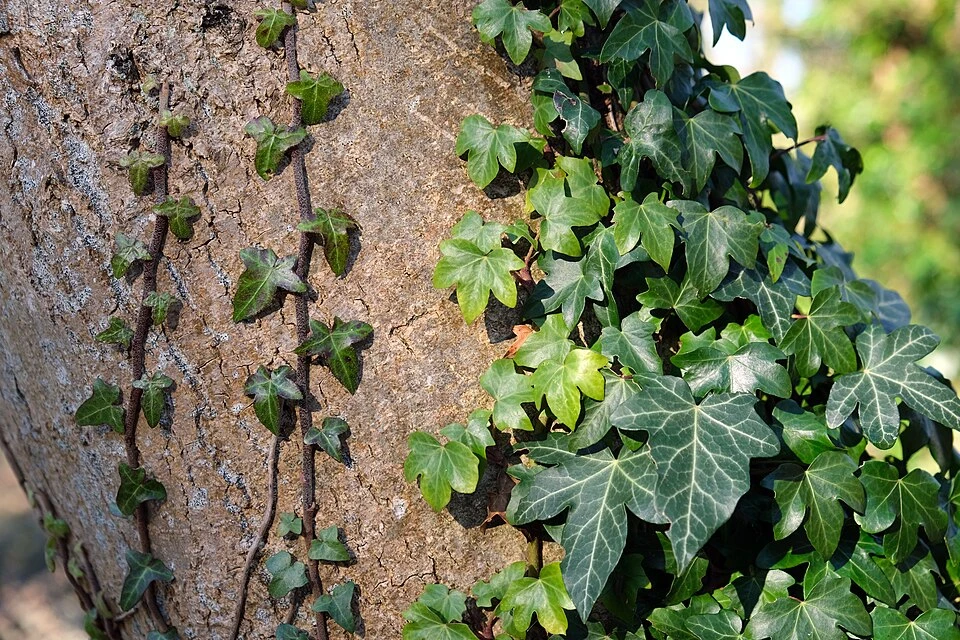
Ivy - Hedera helix
You'll find wild ivy in Europe, Africa, and Asia. It's pretty common around here too. It climbs up tall trees, rocks, and likes shady spots. Ivy is evergreen and a natural climber.
The leaves come in two types: whole-edged, elliptical, or reverse egg-shaped on the flowering stem. On the vegetative stem, they're lobed, either three or five parts. They're dark green, but some varieties have variegated patterns.
Mature plants bloom at the end of summer. In the fall, they produce violet-black fruits that ripen the following year. The flowers are grouped in an umbel and aren't really decorative. For floristry, many variegated forms with white or yellow spots have been developed. There's a variety in leaf size, shape, and arrangement on the branches. The largest is the tricolor variety. Ivy is mostly propagated through stem cuttings. It's easy to root since aerial roots form on the stem and turn into real roots in the soil. Cuttings should be 8-10 cm long. You can root them anytime as long as there's enough moisture and a temperature of 18-20 degrees. Rooting happens directly in the pots where the mature plants will grow. Plant several cuttings in one pot to create a dense cluster. You can also root them by planting closely in perlite or water. No matter the method, keep high humidity around the cuttings by misting them. Use a nutrient-rich substrate for planting. Once the plants take root, start pinching them back. This step is crucial for getting well-shaped plants. During summer, water and mist them often. Apply liquid fertilizers weekly. You can also spray weak solutions on the leaves, which is especially useful in the cooler months. Ivy thrives in shade or partial shade. In winter, it can handle low temperatures. Variegated forms are a bit fussier.

The main pests are mealybugs and scale insects. A sure sign of scale insects is a sticky substance on the leaves, which later develops black mold. Use insecticides to deal with them. Ivy is great for both outdoor and indoor greenery.